Devon · EX7
Thermal imaging survey in Dawlish
Thermal surveys in Dawlish, where extensive post-war bungalow development on the cliff tops takes some of the most storm-exposed weather on the South Devon coast.
Cliff-top bungalows in real numbers
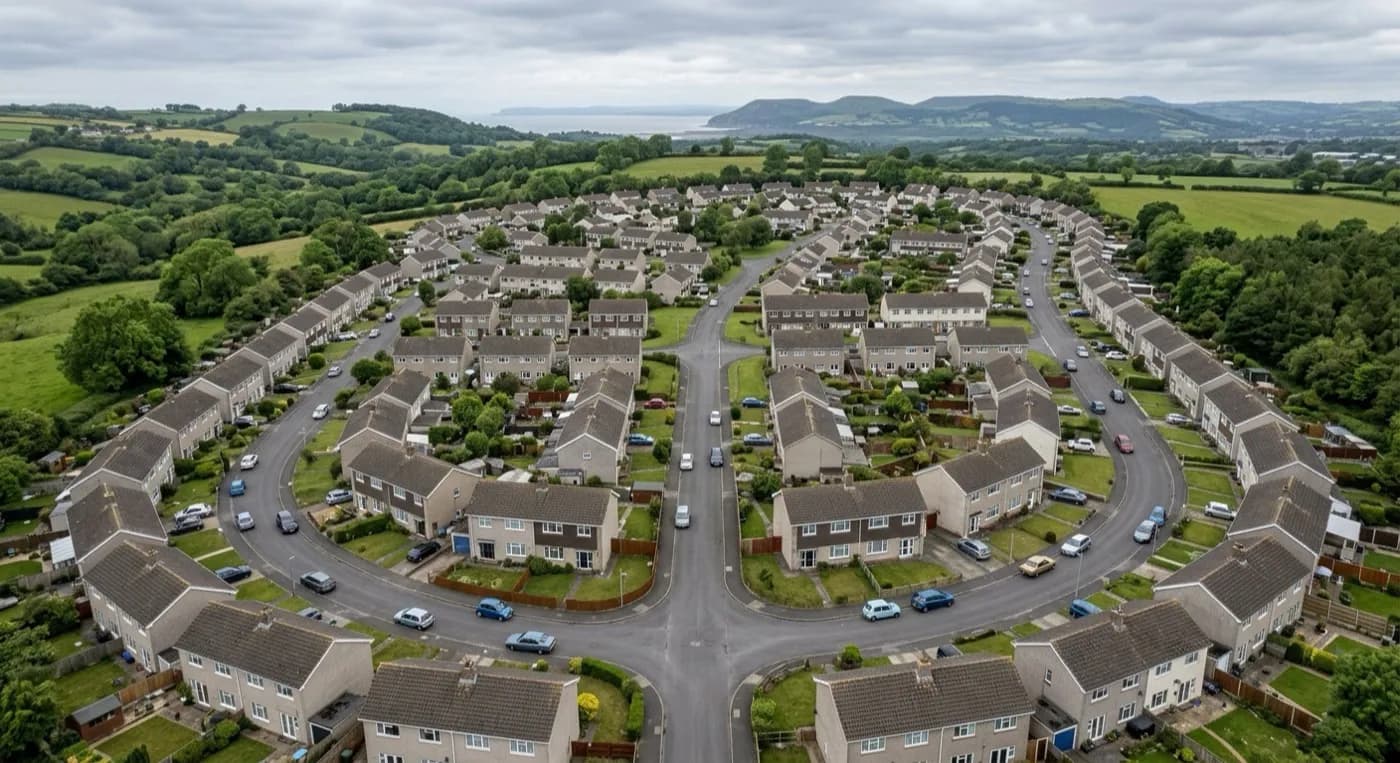
Dawlish's most extensive housing stock by volume is post-war bungalow development on the cliff tops, low, shallow-pitched roofs covering most of a small footprint, built in real numbers rather than as isolated examples. As at Seaton, that construction type means a loft insulation gap has a disproportionate effect on the whole building, because there is comparatively little wall area and comparatively a lot of roof relative to the size of the house.
Regency and Victorian terraces around The Lawn and Dawlish Water form an older, solid-wall core, seafront hotels and apartment blocks bring flat-roofed sections into the mix along the front, and modern estates inland at Dawlish Warren carry the newest construction standard, so the town spans nearly as wide a construction range as Newton Abbot or Plymouth despite its smaller size.
Among the most storm-exposed weather in this coverage area
Dawlish sits among the most storm-exposed places on the South Devon coast, with south-easterly gales throwing sea water directly over the railway wall and the cliff-top bungalow estates taking unbroken wind with nothing to slow it down before it arrives. That level of exposure means the cliff-top bungalows are simultaneously the town's most heat-loss-prone building type, by roof-to-wall ratio, and its most weather-battered, which is exactly the combination that makes a genuine thermal reading valuable rather than academic here.
For the seafront hotels and apartment blocks, the same storm exposure is primarily a flat-roof moisture question, wind-driven rain finding weaknesses at parapets and rooflights that a calmer coastal town would rarely test to the same degree.
Flying between storms rather than around a fixed date
Given how frequently this stretch of coast sees actually severe weather, flight timing here is planned around a settled window rather than a fixed date, watching the forecast for a calm enough spell to fly safely and to get a reading uncomplicated by very recent storm damage.
Once conditions allow, a dawn flight after a cold, clear night suits the bungalow stock and inland terraces, while an evening flight after a bright day is the better choice for the seafront flat-roofed sections.
Dawlish Warren, at the town's northern edge, is both a nature reserve and the location of some of the more recent housing development inland, a actually different construction generation to the storm-battered cliff-top bungalows a short distance south, and a useful marker for the point where the town's exposure noticeably eases. A survey on a Warren-side property is planned to the standard modern cavity rule, while anything nearer the sea wall and the cliff top follows the storm-window planning described above, and naming which side of that line a property sits on speeds up the booking considerably.
Behind the survey
What Dawlish clients are actually buying
CAA registered
Operator ID and Flyer ID held, plus the A2 Certificate of Competency. Every flight, including the early morning and after-dark ones this survey often needs, is planned to the rules that apply to the site.
Radiometric thermal camera
A DJI Mavic 2 Enterprise Advanced carrying a 640 by 512 radiometric sensor. Radiometric means every pixel is an actual temperature reading, not just a colour, which is what makes a genuine comparison across a roof or a wall possible.
100 megapixel visual pass
A DJI Mavic 4 Pro with a Hasselblad camera flies alongside the thermal camera on every job, so a warm or cool patch on the thermal image can be matched back to the actual roof feature or wall detail underneath it.
Insured with Coverdrone
Full commercial cover for the operation. Certificates go to managing agents, landlords and insurers as a matter of course, without anyone having to chase for them.
Nearby
Also covered around Dawlish
- TeignmouthThermal surveys in Teignmouth, where Georgian and Regency seafront terraces and converted flats face an unusual easterly exposure most South West detailing ignores.
- ExeterThermal surveys across Exeter, where solid Georgian and Victorian walls in the old quarters and mass cavity-built estates on the outer ring lose heat in almost opposite ways.
- Newton AbbotThermal surveys in Newton Abbot, where large numbers of Victorian railway-era terraces sit beside extensive post-war estates on the damp, low-lying floodplain of the Teign.
- ExmouthThermal surveys in Exmouth, where Regency and Victorian solid-wall villas share the town with seafront flat-roofed apartment blocks that lose heat in a completely different way.
See what it can and cannot see
Book a thermal survey in Dawlish
Send the address and what is worrying you. Sam Hembury will come back with a fixed price and the next slot that suits the weather.