Devon · EX14
Thermal imaging survey in Honiton
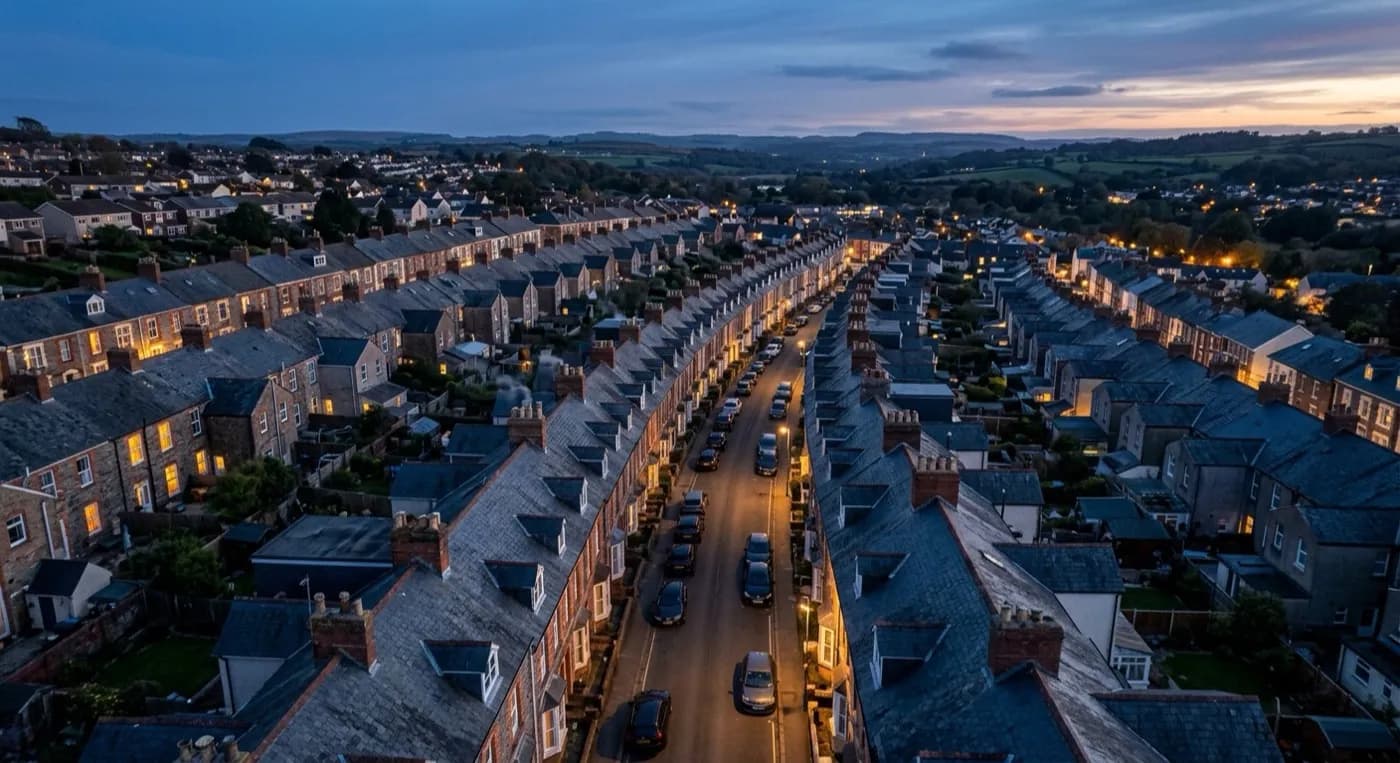
Thermal surveys in Honiton, where a famously uniform Georgian high street sits in a valley prone to sitting fog, keeping roofs and walls damp through the winter months.
A Georgian rebuild, and what came after it
Honiton's high street is famously uniform because it was substantially rebuilt after eighteenth century fires, which means the solid-wall stock along it shares a construction date and a construction method more closely than in most towns of similar size, useful context when comparing a thermal reading from one property against its neighbour. Behind the high street, Victorian additions and then substantial post-war and modern estates to the north and west bring in the full range of cavity-era construction, so the town covers almost the entire span of building ages this site is built around, all within walking distance of the centre.
The thatched cottages on the outskirts are a specific case worth naming separately: thatch is itself a substantial layer of insulation, but a thermal reading through it behaves differently to a reading through slate or tile, and a survey on a thatched property is planned with that in mind rather than treated identically to the tiled stock nearby.
The fog problem
The town is sheltered from the sea but exposed to weather coming over the Blackdown Hills to the north and east, and the Otter valley here is prone to sitting fog that keeps roofs and walls damp through the winter months even without active rain. A wall or roof that never fully dries out between wet spells loses heat consistently rather than only during a storm, which is a slower, less dramatic but ultimately more costly pattern than the sudden exposure some coastal towns on this list see.
That persistent damp also affects when a flight can usefully go up: a actually foggy or misty morning is a poor time to fly regardless of temperature, because visibility and lens condition matter as much as the thermal reading itself, so timing here weighs the forecast for fog as carefully as it weighs temperature.
Covering a town with almost every construction era present
Because Honiton spans Georgian rebuild, Victorian infill, post-war estate and modern development within a small area, a survey booking here often starts with a conversation about which part of the town the property sits in, since that alone gives a strong steer on what kind of finding is most likely before the aircraft has even gone up.
A dawn flight once any overnight fog has cleared is the usual plan, giving the clearest possible read across whichever era of building is being surveyed.
Dumpdon Hill, rising sharply above the Otter valley to the north east, is a useful landmark for judging how exposed a particular street in Honiton actually is, properties on the lower ground toward the river sit in the valley's fog and damp far more than those higher up towards the hill, even within a short distance of each other. The town's lace-making heritage also left a scatter of specialist workshop buildings behind the high street, often converted to residential use since, and like any conversion their insulation history is mixed rather than uniform, worth reading on its own terms rather than assumed from the frontage.
Behind the survey
What Honiton clients are actually buying
CAA registered
Operator ID and Flyer ID held, plus the A2 Certificate of Competency. Every flight, including the early morning and after-dark ones this survey often needs, is planned to the rules that apply to the site.
Radiometric thermal camera
A DJI Mavic 2 Enterprise Advanced carrying a 640 by 512 radiometric sensor. Radiometric means every pixel is an actual temperature reading, not just a colour, which is what makes a genuine comparison across a roof or a wall possible.
100 megapixel visual pass
A DJI Mavic 4 Pro with a Hasselblad camera flies alongside the thermal camera on every job, so a warm or cool patch on the thermal image can be matched back to the actual roof feature or wall detail underneath it.
Insured with Coverdrone
Full commercial cover for the operation. Certificates go to managing agents, landlords and insurers as a matter of course, without anyone having to chase for them.
Nearby
Also covered around Honiton
- AxminsterThermal surveys in Axminster, where a hilltop Georgian and Victorian centre sits fully exposed to wind from every direction, with former mill buildings and post-war estates around it.
- CullomptonThermal surveys in Cullompton, where cob and thatch survive in the old lanes behind a Georgian Fore Street, outnumbered by a large and continuing spread of modern estate housing.
- SidmouthThermal surveys in Sidmouth, where an unusually complete Regency core with complex rendered roof geometries sits below later valley-side villas and post-war Sidford housing.
See what it can and cannot see
Book a thermal survey in Honiton
Send the address and what is worrying you. Sam Hembury will come back with a fixed price and the next slot that suits the weather.