Devon · EX12
Thermal imaging survey in Seaton
Thermal surveys in Seaton, where a large stock of shallow-pitched post-war bungalows sits behind Victorian seafront terraces, each losing heat through a different roof shape entirely.
Bungalows on the slopes, terraces on the front
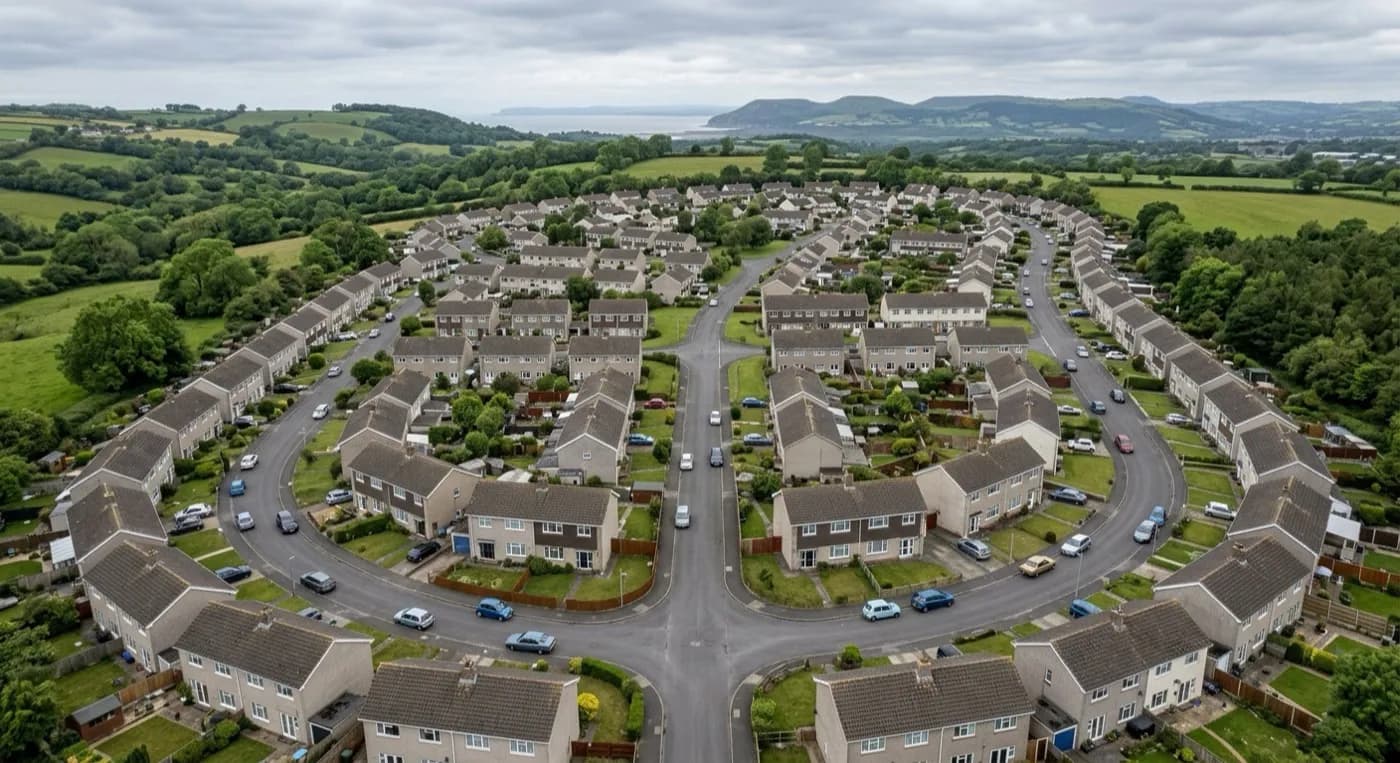
Seaton carries an unusually large stock of post-war bungalows on the slopes behind the seafront, low, shallow-pitched roofs with a smaller loft void than a Victorian house and, on many of the older ones, insulation that was fitted to a standard nobody would specify today. Because a bungalow's roof covers most of the building's footprint, a thin or patchy loft here has a disproportionate effect on the whole property's heat loss compared with the same gap in a two-storey terrace.
The seafront itself is Victorian and Edwardian terrace, solid wall behind a shingle beach only a few metres away, plus a scatter of holiday flats and chalets that were often built or converted quickly and cheaply, which is its own thermal question: a chalet roof or a flat conversion ceiling is frequently under-insulated in a way that was never properly documented when the work was done.
Exposure that shallow roofs handle badly
Seaton is directly exposed to the south with the beach only a few metres from the front row of properties, and salt spray combined with gale-driven rain is the defining weather problem here. Shallow bungalow pitches shed wind-driven rain poorly compared with a steeper Victorian roof, so moisture sits and works into roof penetrations and eaves details for longer, which both damages the building and undermines whatever insulation is packed into that shallow void.
Colyford and the modern estates towards it are a more conventional, better-sheltered inland picture, and a thermal survey there is closer in character to any modern South West cavity estate than to the exposed bungalow stock nearer the front.
What gets flown, and why the bungalow stock comes first
For the bungalow stock, a whole-roof thermal pass is usually the more useful survey than a single-room targeted one, because the roof void is small enough that a gap in one area is likely to be part of a wider pattern rather than an isolated problem.
A dawn flight after a cold, clear night works well across the whole town, with the exposed seafront and bungalow slopes checked first while the temperature difference from overnight is still at its widest.
The Seaton Tramway corridor, running up the Axe valley towards Colyford, roughly marks the line between the older bungalow stock nearer the seafront and the more recent estates further inland, and that line is a useful rough guide when booking a survey, since the construction era and therefore the likely finding changes noticeably either side of it. Along the Axe Estuary Wetlands to the east, the last few streets of housing share the same low-lying, salt-exposed position as the seafront itself, and those properties are flown with the same care around tide and weather as the front row on the beach.
Behind the survey
What Seaton clients are actually buying
CAA registered
Operator ID and Flyer ID held, plus the A2 Certificate of Competency. Every flight, including the early morning and after-dark ones this survey often needs, is planned to the rules that apply to the site.
Radiometric thermal camera
A DJI Mavic 2 Enterprise Advanced carrying a 640 by 512 radiometric sensor. Radiometric means every pixel is an actual temperature reading, not just a colour, which is what makes a genuine comparison across a roof or a wall possible.
100 megapixel visual pass
A DJI Mavic 4 Pro with a Hasselblad camera flies alongside the thermal camera on every job, so a warm or cool patch on the thermal image can be matched back to the actual roof feature or wall detail underneath it.
Insured with Coverdrone
Full commercial cover for the operation. Certificates go to managing agents, landlords and insurers as a matter of course, without anyone having to chase for them.
Nearby
Also covered around Seaton
- AxminsterThermal surveys in Axminster, where a hilltop Georgian and Victorian centre sits fully exposed to wind from every direction, with former mill buildings and post-war estates around it.
- SidmouthThermal surveys in Sidmouth, where an unusually complete Regency core with complex rendered roof geometries sits below later valley-side villas and post-war Sidford housing.
- Lyme RegisThermal surveys in Lyme Regis, where dense historic cottages on near-vertical streets sit on an actively unstable landslip coast that adds ground movement to the usual coastal exposure.
- HonitonThermal surveys in Honiton, where a famously uniform Georgian high street sits in a valley prone to sitting fog, keeping roofs and walls damp through the winter months.
See what it can and cannot see
Book a thermal survey in Seaton
Send the address and what is worrying you. Sam Hembury will come back with a fixed price and the next slot that suits the weather.