Somerset · TA21
Thermal imaging survey in Wellington
Thermal surveys in Wellington, where a Georgian and Victorian mill town with terraced mill workers' housing sits below an escarpment that accelerates wind over the town.
A mill town's terraces, and the mills themselves
Wellington's centre is Georgian and Victorian with a strong woollen mill legacy, and the terraced mill housing built for that industry carries the same thinner, more repeated construction found in other Devon and Somerset mill and railway towns on this list, solid wall built quickly for a working population rather than to a generous specification. The former mill buildings themselves, at Tonedale and elsewhere, are large-span structures with a completely different roof and wall behaviour to a domestic building, and any residential conversion of that kind of space carries the same mixed-history thermal picture as a barn conversion inland.
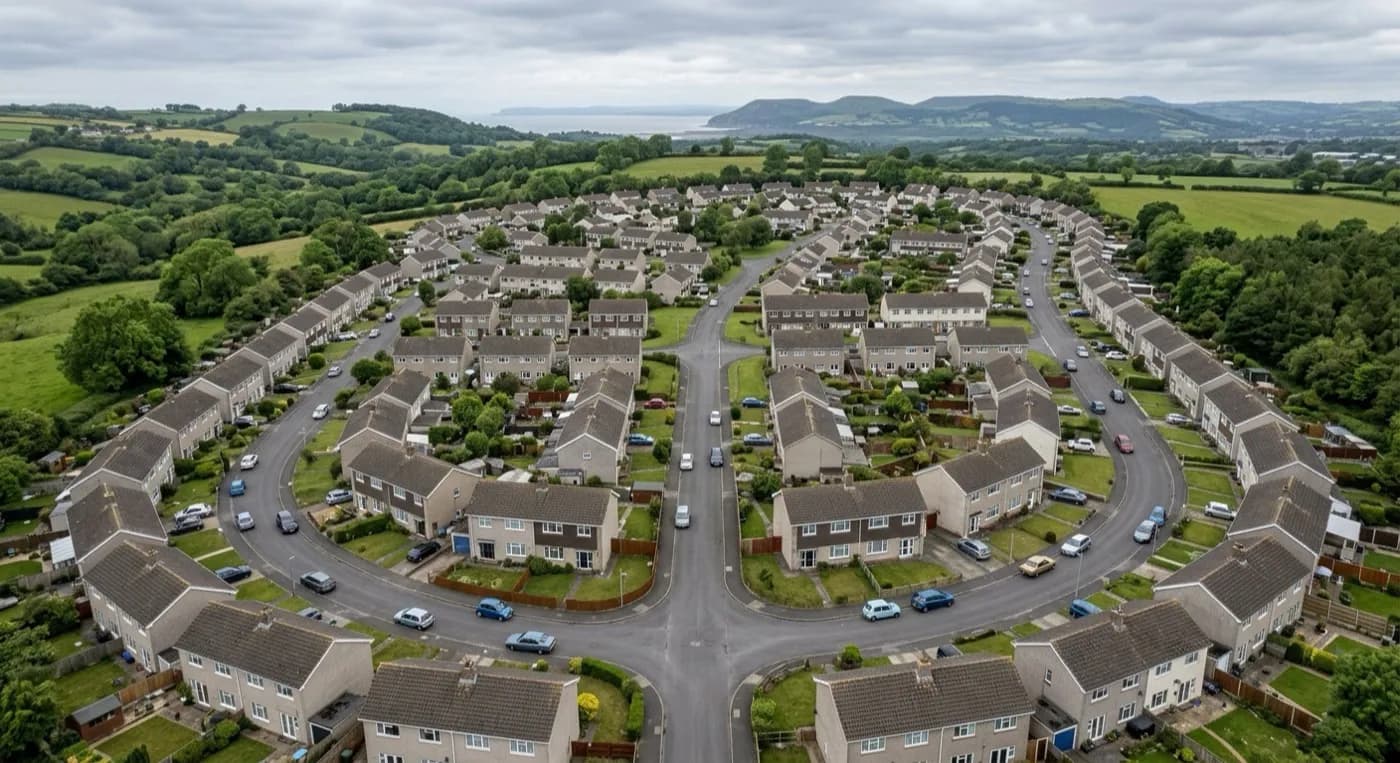
Substantial post-war and modern estates spread north and east of the historic core, bringing the town's newest housing closer to the familiar cavity standard found across most of this coverage area's more recently built stock.
An escarpment that accelerates the wind overhead
The Blackdown escarpment sits immediately south of the town, with the Wellington Monument on the ridge above, and that escarpment produces marked wind acceleration over the town during south-westerly weather, a well-documented local effect rather than a general assumption about hill towns. The higher streets, closer to the escarpment's influence, feel that acceleration far more than the valley floor below, which means two mill terraces a short walk apart can actually experience quite different wind-driven rain exposure on the same stormy day.
For the terraced mill housing on the more exposed higher streets, that additional wind loading drives rain into reveals and joints harder and more often than the same style of building would experience on the sheltered valley floor, with the usual consequence for a solid wall: more time spent damp means more heat lost, consistently, over a winter.
Flying below an escarpment with real local wind effects
Given the documented wind acceleration off the escarpment, flight timing here pays particular attention to forecast wind speed and direction relative to the town's position under the ridge, more so than a flatter site would require.
A dawn flight after a cold, clear night is the usual plan once conditions allow, giving a clear read across both the mill terraces on the higher streets and the more sheltered post-war estates below.
Wellington Park and the streets nearest it sit close to the historic mill town centre, sharing the same terraced construction as the wider core, while the former Tonedale Mills buildings themselves, where residential conversion has taken place, carry the mixed thermal history typical of any large-span industrial building turned into homes. A survey on a Tonedale conversion is read against the building's original industrial fabric rather than assumed to match the terraced housing nearby, since the two were built for entirely different purposes and behave differently under a thermal camera as a result.
Behind the survey
What Wellington clients are actually buying
CAA registered
Operator ID and Flyer ID held, plus the A2 Certificate of Competency. Every flight, including the early morning and after-dark ones this survey often needs, is planned to the rules that apply to the site.
Radiometric thermal camera
A DJI Mavic 2 Enterprise Advanced carrying a 640 by 512 radiometric sensor. Radiometric means every pixel is an actual temperature reading, not just a colour, which is what makes a genuine comparison across a roof or a wall possible.
100 megapixel visual pass
A DJI Mavic 4 Pro with a Hasselblad camera flies alongside the thermal camera on every job, so a warm or cool patch on the thermal image can be matched back to the actual roof feature or wall detail underneath it.
Insured with Coverdrone
Full commercial cover for the operation. Certificates go to managing agents, landlords and insurers as a matter of course, without anyone having to chase for them.
Nearby
Also covered around Wellington
- TauntonThermal surveys in Taunton, where a Georgian and Victorian county town centre is now surrounded on all four sides by very large post-war and continuing new-build estates.
- CullomptonThermal surveys in Cullompton, where cob and thatch survive in the old lanes behind a Georgian Fore Street, outnumbered by a large and continuing spread of modern estate housing.
- TivertonThermal surveys in Tiverton, where Victorian mill workers' terraces on steep streets sit below extensive post-war and large modern estates on the eastern edge of the town.
See what it can and cannot see
Book a thermal survey in Wellington
Send the address and what is worrying you. Sam Hembury will come back with a fixed price and the next slot that suits the weather.